

Canada Employment Guide 2026: BC Minimum Wage Increase and Key Hiring Compliance Updates
Canada Employment Guide 2026: BC Minimum Wage Increase and Key Hiring Compliance Updates
Canada employment guide, canada eor,canada labor law
Check recruitment costs
Currency
Canadian Dollar (CAD, $)
Capital
Ottawa
Official language
English and French
Salary Cycle
Weekly, Biweekly
Our Guide in Canada
Browse the following tags to learn all about Canada
Businesses planning to hire employees in Canada should understand that employment compliance is governed by a combination of federal and provincial employment laws rather than a single nationwide standard. Key employment requirements—including minimum wage rates, working hours, leave entitlements, termination obligations, payroll contributions, and foreign worker pathways—vary significantly by province, industry, and job classification.
As a result, employers expanding into Canada must carefully assess local labor laws and employment standards based on the employee's work location. This is particularly important for companies using an Employer of Record (EOR), establishing local entities, or building distributed teams across multiple provinces.
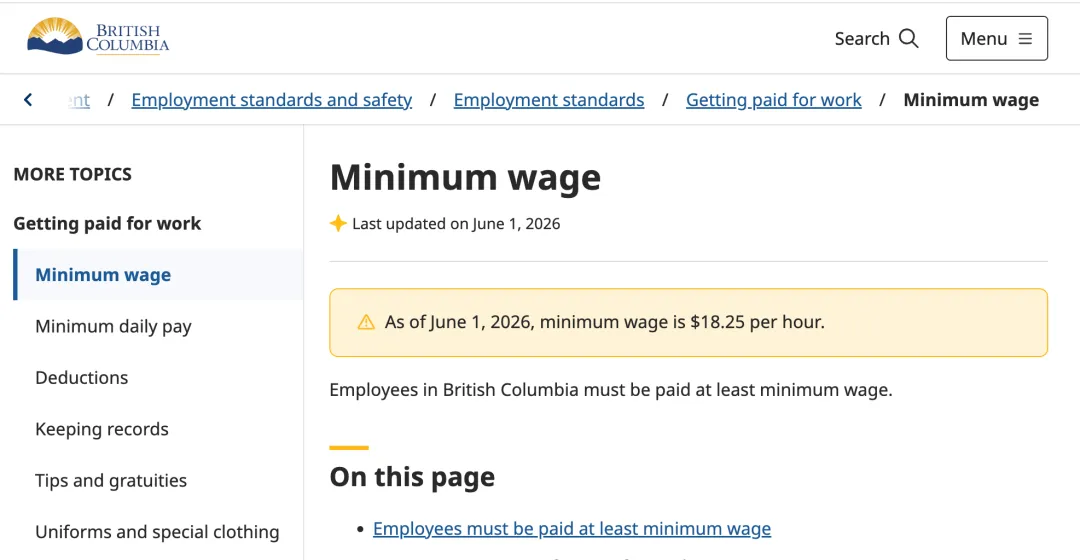
A recent example is the minimum wage increase in British Columbia (BC). Effective June 1, 2026, BC's general minimum wage increased from CAD 17.85 per hour to CAD 18.25 per hour, with corresponding adjustments for several special employee categories.
For employers operating in British Columbia, this update may impact payroll budgeting, labor costs, employment contracts, workforce planning, and overall compliance obligations. Companies should review their compensation structures and HR policies to ensure alignment with the latest BC employment standards and Canada employment law requirements.
Whether you are hiring local employees, relocating talent, or expanding your workforce through an EOR solution, staying current with provincial employment regulations is essential to maintaining compliance and avoiding costly employment-related risks.
Basic Information About Canada
- Official Languages: English and French
- Currency: Canadian Dollar (CAD)
- Capital City: Ottawa
- Key Business Hubs
Toronto Canada’s largest business center, with strong concentrations of financial services, technology, corporate headquarters, and sales operations.
Vancouver A major hub for international trade, logistics, cross-border e-commerce, technology, and Asia-Pacific business connectivity.
Montreal Known for its thriving AI ecosystem, aerospace industry, and creative sectors. Employers should pay particular attention to French language requirements and Quebec-specific employment regulations.
Calgary A leading center for energy, engineering, renewable energy, and resource-based industries.
Ottawa As the capital of Canada and home to the federal government, Ottawa has a strong presence in technology, telecommunications, public affairs, and government-related sectors.
Chinese companies expanding into Canada are commonly involved in industries such as: Energy and mining, Renewable energy and battery technology, Automotive manufacturing and supply chains, Cross-border e-commerce, Logistics and transportation, Technology and digital services, Fintech and financial services, Consumer brands and retail.
Before Hiring in Canada
Regulatory Framework: Federal and Provincial Rules
Canada operates under a federal system, and employment laws are governed at both the federal and provincial levels.
Federally regulated industries—including banking, telecommunications, aviation, railways, and certain transportation sectors—are subject to the Canada Labour Code. Most other industries fall under provincial or territorial employment legislation, meaning employers must comply with the rules of the province where the employee actually performs their work.
Quebec follows a Civil Law system, which differs from the common law framework used in most other provinces. Employment contracts, HR documentation, and employee communications in Quebec may be subject to French language requirements and additional local compliance obligations. Employers should assess Quebec-specific requirements separately.
Employment Contracts
Permanent Employment Contracts
Permanent (indefinite-term) contracts do not have a specified end date and are commonly used for long-term positions, core team members, and ongoing workforce needs. If an employment agreement does not clearly define a fixed term, it is generally considered a permanent employment relationship.
Fixed-Term Employment Contracts
Fixed-term contracts specify a defined start and end date and typically terminate automatically upon expiration. Canada does not have a nationwide maximum duration for fixed-term contracts. Whether a fixed-term arrangement is valid depends on the contract terms, applicable provincial employment standards, common law principles, or Quebec civil law requirements.
For employees located in Quebec, employers should also consider French-language contract requirements, local labour standards, and the province’s civil law framework. Employment templates designed for provinces such as Ontario or British Columbia should not be applied to Quebec without proper review.
Other Employment Arrangements
Common alternative employment arrangements include:
Part-time Employment Typically applies to positions with working hours below a company's full-time schedule, while remaining protected under applicable employment standards and labor regulations.
Casual Employment Commonly used for replacement staffing, seasonal work, or on-demand workforce needs, where employees are engaged as business requirements arise.
Contract-Based Employment Often used for projects with a defined scope or duration, particularly in industries such as IT development, construction, engineering, and consulting.
Rotational Employment Frequently adopted in mining, oil and gas, energy, and large-scale project operations, where employees work on a scheduled rotation basis, often involving remote sites, international assignments, or project-based deployments.
Working Hours and Overtime
Working time regulations vary across Canada's provinces and territories.
Standard working hours generally range from 40 to 44 hours per week, depending on the applicable jurisdiction. Federally regulated employees typically follow a 40-hour workweek, while provinces such as Ontario use a 44-hour threshold.
Overtime
- Overtime is generally compensated at 1.5 times the employee's regular rate of pay, subject to applicable employment standards.
- Work performed on public holidays may trigger holiday pay, premium pay, substitute leave, or a combination of these benefits.
- Compensation for work on regular rest days depends on provincial legislation, scheduling arrangements, and any applicable exemptions.
- Night shift or shift premiums may be governed by provincial rules, collective bargaining agreements, or employer policies.
Provincial Variations
Key differences among jurisdictions include:
- Federally regulated employees generally follow a standard workweek of 40 hours, with a maximum of 48 hours per week unless specific exceptions apply under the Canada Labour Code.
- In Ontario, overtime pay is generally required for hours worked beyond 44 hours per week.
- Some provinces impose additional requirements regarding rest periods, consecutive working days, scheduling practices, and meal breaks.
- In British Columbia, overtime pay is generally triggered after 8 hours worked in a day or 40 hours worked in a week, subject to applicable employment standards.
Compensation, Employer Costs, Leave Entitlements, and Termination Rules
Minimum Wage
Canada does not have a single nationwide minimum wage applicable to all employees. Employers must comply with the minimum wage requirements of the province or territory where the employee performs their work.
Minimum wage rates across many provinces increased between 2025 and 2026. The table below provides a reference for several commonly used jurisdictions (as of June 3, 2026).
Province | CAD |
Federal | 18.15 |
British Columbia (BC) | 18.25 |
Ontario | 17.6 |
Alberta | 15 |
Quebec | 16.6 |
Saskatchewan | 15.35 |
Typical Employer Costs
Canada Pension Plan (CPP) / Quebec Pension Plan (QPP)
Employers outside Quebec generally contribute to the Canada Pension Plan (CPP). Employers in Quebec participate in the Quebec Pension Plan (QPP), which operates separately.
Employment Insurance (EI)
For employees outside Quebec, employers generally contribute Employment Insurance premiums at 1.4 times the employee contribution rate. Based on the 2026 employee EI contribution rate of 1.63%, the employer contribution rate is typically 2.282%.
Provincial Workers' Compensation Insurance
Workers' compensation premiums are administered at the provincial level and vary depending on the province, industry classification, and occupational risk profile.
Leave Entitlements
Paid Annual Vacation
The federal standards below apply only to employees covered by the Canada Labour Code. Employees governed by provincial employment legislation are subject to the vacation requirements of their respective province or territory.
Tenure | Annual Leave |
1-5 yr | 2 weeks |
5-10 yr | 3 weeks |
10 yr+ | 4 weeks |
Vacation entitlements vary significantly across jurisdictions. A common framework provides two weeks of paid vacation initially, increasing to three weeks after a specified period of service. However, eligibility requirements, vacation pay percentages, and service thresholds differ by province. Employers should verify the applicable rules based on the employee's work location.
Sick Leave
Sick leave entitlements vary under federal and provincial legislation and should be assessed according to the applicable jurisdiction.
Other Statutory Leave
Maternity and parental leave arrangements involve two separate components:
- Employment-protected leave under federal or provincial employment standards legislation.
- Income replacement benefits available through Employment Insurance (EI) or the Quebec Parental Insurance Plan (QPIP).
Eligibility requirements, benefit durations, and payment structures vary by jurisdiction and program.
Additional protected leaves may include:
- Bereavement leave
- Family caregiver leave
- Compassionate care leave
- Jury duty leave
- Domestic or sexual violence leave
- Other statutory leaves prescribed by federal or provincial law
Employers should review the requirements applicable to the employee's jurisdiction.
Termination of Employment
Overview of Termination Requirements
In Canada, termination obligations cannot be assessed solely based on statutory minimum notice requirements.
In common law provinces, employees may be entitled to reasonable notice that exceeds statutory minimum standards. Courts often consider factors such as:
- Length of service
- Age of the employee
- Position and level of responsibility
- Compensation level
- Availability of comparable employment opportunities
Before terminating employment, employers should evaluate:
- Whether federal or provincial employment legislation applies
- Whether the employment agreement contains an enforceable termination clause
- Whether human rights protections are involved
- Whether the employee is on protected leave (such as maternity, parental, disability, or workers' compensation leave)
- Whether termination pay, severance pay, accrued vacation pay, or benefit continuation obligations apply
- Whether the employee's work permit or immigration status may be affected
Employers should also exercise caution when terminating fixed-term employment contracts before their scheduled expiry. If the contract does not contain a valid early termination provision, significant damages may be payable.
Notice Periods
Federal Statutory Notice
The standards below apply only to federally regulated employees covered by the Canada Labour Code. Employees governed by provincial employment legislation are subject to provincial notice requirements.
Length of service | Statutory Notice Period |
under 3 months | N/A |
3 months - 3 years | 2 weeks |
3 years | 3 weeks |
4 years | 4 weeks |
5 years | 5 weeks |
6 years | 6 weeks |
7 years | 7 weeks |
over 8 years | 8 weeks |
Common Law Reasonable Notice
In common law provinces such as Ontario, Alberta, and British Columbia, employees may be entitled to reasonable notice that exceeds statutory minimum requirements.
Courts typically assess reasonable notice based on factors including:
- Length of service
- Age
- Position and seniority
- Prospects for securing comparable employment
Reasonable notice is highly fact-specific and should not be calculated solely based on years of service. Senior executives, long-serving employees, or individuals facing greater challenges in finding comparable employment may be entitled to substantially longer notice periods than the statutory minimum.
Length of service | Period Reference |
1-4 years | 1-3 months |
4-8 years | 3-6 months |
8-15 years | 6-12 months |
over 15 years | 12-24 months |
Pay in Lieu of Notice
Rather than requiring an employee to work through the notice period, employers may provide pay in lieu of notice.
The payment amount generally must cover compensation that would have been earned during the applicable notice period, including wages and, where required, the continuation of benefits. Entitlements depend on the applicable legislation, employment contract, and specific circumstances of the termination.
Disclaimer
The information and opinions provided are for reference only and do not constitute legal, tax, or other professional advice. sailglobal strives to ensure the accuracy and timeliness of the content; however, due to potential changes in industry standards and legal regulations, sailglobal cannot guarantee that the information is always fully up-to-date or accurate. Please carefully evaluate before making any decisions. sailglobal shall not be held liable for any direct or indirect losses arising from the use of this content.

Hire easily in Canada
Use the employee cost calculator to estimate employer-side totals, management fees, and employment burden by country and salary—run payroll-style numbers before you sign or pay, so global hiring stays predictable.