

Malaysia Employment Pass (EP) 2026 Guide | Salary, Visa Types, Requirements & Policy Updates
Malaysia Employment Pass (EP) 2026 Guide | Salary, Visa Types, Requirements & Policy Updates
malaysia EP, visa application, salary
Check recruitment costs
Currency
Malaysian Ringgit (MYR)
Capital
Kuala Lumpur
Official language
Malay (Bahasa Malaysia)
Salary Cycle
Monthly
Our Guide in Malaysia
Browse the following tags to learn all about Malaysia
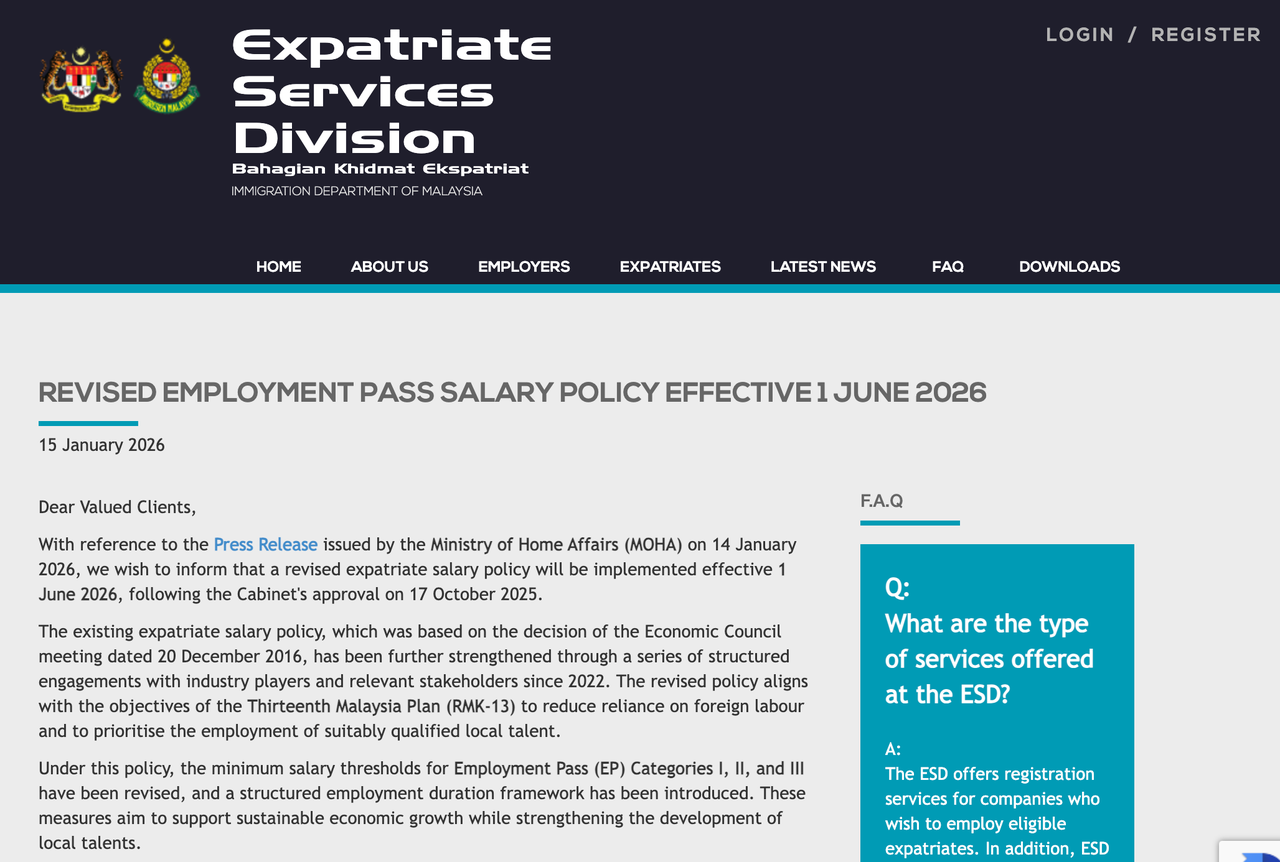
Starting from June 1, 2026, Malaysia’s updated Employment Pass (EP) salary requirements have officially come into effect. Companies posting Chinese employees, hiring foreign professionals, or deploying teams in Malaysia through an EOR model should review and adjust their salary budgets, visa categories, and onboarding plans accordingly.
This update not only involves revised EP salary thresholds, but also requires companies to pay attention to the rollout of ePASS digital endorsement, as well as the 1:3 Internship Policy related to EP applications.
EP Salary Policy
According to official announcements from ESD / MYXpats, all new Employment Pass (EP) applications and renewals submitted on or after June 1, 2026 must comply with the updated salary thresholds:
EP Category | Minimum Monthly Salary (from June 1, 2026) | Pass Duration |
Category I | RM20,000 and above | Up to 10 years |
Category II | RM10,000 – RM19,999 | Up to 10 years (usually requires a succession plan) |
Category III | RM5,000 – RM9,999 | Up to 5 years (usually requires a succession plan) |
This adjustment has a direct impact on companies’ workforce planning:
- Professional positions previously planned around RM10,000 may no longer qualify for Category I
- Both new applications and renewals will require reassessment of salary categorization
- EOR and local employment models must recalculate budgets in line with the updated thresholds
ePASS
According to the ESD announcement, starting from March 1, 2025, ePASS has been implemented for endorsement processes across multiple pass categories, including Employment Pass (EP), Professional Visit Pass (PVP), Resident Pass – Talent (RP-T), and Dependent Pass (DP).
The key change introduced by ePASS is the improvement in the application experience. Instead of relying entirely on traditional physical sticker endorsements, certain endorsement processes can now be completed online, making the procedure more digitalized and efficient.
Internship Policy
This policy officially came into effect on June 1, 2026, with the objective of linking foreign talent employment with local talent development in Malaysia.
In simple terms, when companies apply for an Employment Pass (EP) for foreign employees, in addition to salary level, job role, and employer eligibility, they are also required to support local internship placements.
EP Category | Internship Requirement Ratio |
Category I | 1 EP I = 3 internship positions |
Category II | 1 EP II = 2 internship positions |
Category III | 1 EP III = 1 internship position |
If the total number of internship placements exceeds 2% of the company’s total workforce, the internship requirement may be capped at 2% of the company’s headcount.
According to the official announcement, internships must be structured and paid under the MySIP-endorsed internship framework, typically lasting no less than 10 weeks, with minimum stipends determined based on the trainee’s study level.
Main Work Visa Types in Malaysia
Route | Visa Type | Key Eligibility Criteria |
Standard Employment Route | Employment Pass (EP) | Foreign professionals with a Malaysian employer sponsor; salary thresholds vary by category |
Short-Term Specialist Visit | Professional Visit Pass (PVP) | Short-term technical assignments; up to 12 months; not convertible to EP |
High-Skilled Talent Route | Residence Pass–Talent (RP-T) | High-income or highly skilled foreign professionals; allows residence for up to 10 years |
Dependent Route | Dependant Pass (DP) | Spouse or children of EP holders; not allowed to work independently |
Digital Talent Route | DE Rantau Pass | Digital nomads and remote workers |
Employment Pass (EP) – Work Visa
Malaysia’s most common work visa for foreign professionals, requiring sponsorship from a Malaysian employer.
Target applicants:
- Foreign professionals with specialized skills, managerial capabilities, or technical expertise
- Individuals employed in managerial, technical, or professional roles within Malaysian companies
Professional Visit Pass (PVP)
A short-term pass for foreign experts, technical personnel, or intra-company transferees working temporarily in Malaysia, valid for up to 12 months and not intended for long-term local employment.
Target applicants:
- Short-term technical assignments or intra-company transfers
- Temporary assignments for international organizations
Residence Pass–Talent (RP-T)
A long-term residence pass for high-income, highly skilled individuals, or those with significant contributions to Malaysia. It allows residence for up to 10 years and is one of Malaysia’s most attractive long-term visa options.
Target applicants:
- High-income professionals earning ≥ RM 15,000 per month
- Experts contributing to strategic industries in Malaysia
- Specialized talent employed by Malaysia Digital–approved companies
DE Rantau Digital Nomad Pass
A digital nomad visa introduced by Malaysia for eligible remote workers. It does not grant the right to local employment within Malaysia.
Target applicants:
- Professionals working remotely for overseas employers
Visa-Free Entry Arrangements
Visa-free arrangements are suitable for short-term entry purposes such as tourism and general business visits, but they cannot replace a work permit.
Nationality Category | Typical Visa-Free Duration |
Major developed countries (e.g., UK, US, Japan, South Korea, Singapore, etc.) | 30–90 days |
China | 30 days |
Most developing countries | 30 days |
Visa-Free Entry for Chinese Citizens
Tourism / Business:
Visa-free entry for up to 30 days is available for tourism or business purposes only. Travelers must complete the Malaysia Digital Arrival Card (MDAC) online within 3 days prior to departure via the official Immigration Department website before entering Malaysia.
Work / Study:
If the purpose is employment or study, the appropriate visa must be obtained in advance. It is not permitted to engage in work or study activities while entering Malaysia under visa-free arrangements for tourism or business purposes.
Frequently Asked Questions (FAQ)
Q: What are the common reasons for EP application rejection?
A: Common reasons include salary not meeting the required threshold, insufficient employer eligibility, and incomplete application documents.
Q: What happens to an EP when changing jobs?
A: The Employment Pass (EP) is tied to the employer. Once employment ends, the EP becomes invalid and a new application must be submitted by the new employer. It is recommended to secure a new job offer before resigning to avoid any employment gap or visa status interruption.
Q: Can dependents work in Malaysia?
A: Holders of a Dependant Pass (DP) are not allowed to work in Malaysia. To be legally employed, they must obtain an Employment Pass (EP) sponsored by an employer.
Disclaimer
The information and opinions provided are for reference only and do not constitute legal, tax, or other professional advice. sailglobal strives to ensure the accuracy and timeliness of the content; however, due to potential changes in industry standards and legal regulations, sailglobal cannot guarantee that the information is always fully up-to-date or accurate. Please carefully evaluate before making any decisions. sailglobal shall not be held liable for any direct or indirect losses arising from the use of this content.

Hire easily in Malaysia
Use the employee cost calculator to estimate employer-side totals, management fees, and employment burden by country and salary—run payroll-style numbers before you sign or pay, so global hiring stays predictable.