

New Zealand Employment Guide: 2026 Compensation Updates, Both Minimum Wage and KiwiSaver Contribution Rates Increase
New Zealand Employment Guide: 2026 Compensation Updates, Both Minimum Wage and KiwiSaver Contribution Rates Increase
employment guide, new zealand eor, 2026 compensation updates
Check recruitment costs
Currency
New Zealand Dollar (NZD)
Capital
Wellington
Official language
English
Salary Cycle
Monthly
Our Guide in New Zealand
Browse the following tags to learn all about New Zealand
When hiring employees overseas, understanding local regulations and establishing a clear operational framework are fundamental to achieving compliant employment practices. As part of its New Zealand Employment Guide, sailglobal will continue updating its Global Employment Guide series, bringing together key information on country profiles, compensation and benefits, New Zealand Employment Law, and Employment Compliance in New Zealand requirements. Our goal is to help businesses achieve more efficient and compliant Workforce Expansion in New Zealand and other global markets as they grow internationally.
As of April 1, 2026, there are two employment cost-related policy changes in New Zealand that HR teams of international businesses should pay close attention to. Companies focused on Hiring Employees in New Zealand should carefully review these developments to ensure compliance with New Zealand Labor Laws and evolving employment requirements.
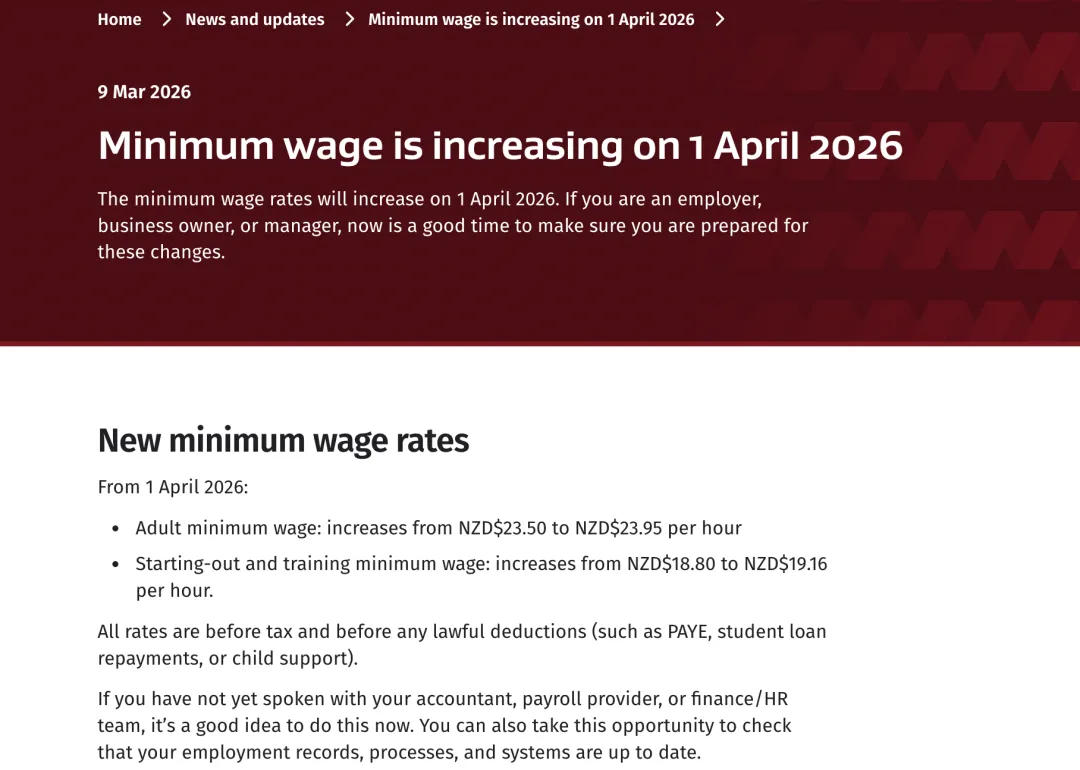
First, the New Zealand Minimum Wage 2026 has increased from NZD 23.50 per hour to NZD 23.95 per hour. This change directly impacts payroll budgets and minimum wage compliance obligations.
Second, for eligible employees participating in the KiwiSaver retirement savings scheme, the minimum employer contribution rate has increased from 3% to 3.5% of gross salary.
As a result, overall labor costs will rise further. Employers should assess the impact of these changes when developing compensation packages and annual workforce budgets while ensuring compliance with local regulations and New Zealand Employment Standards.
Impact on Employers
The adjustments to minimum wages and KiwiSaver contributions may affect:
• Employee compensation levels
• Employer contribution obligations
• Holiday pay calculations
• Overall employment costs
Companies that are Hiring Employees in New Zealand, using an Employer of Record (EOR) New Zealand, or revising compensation budgets should update employment contracts and payroll systems accordingly. Maintaining strong New Zealand Payroll Compliance will help employers manage rising labor costs while remaining compliant with local employment regulations.
Overview & Key Cities for Chinese Businesses
Basic Information
The primary languages spoken in New Zealand are English and Māori.
- Currency: New Zealand Dollar (NZD)
- Capital: Wellington
- Legal System: Common Law
New Zealand's legal framework is primarily based on legislation, judicial precedents, and established legal principles.
Key Business Cities
Auckland
Auckland is New Zealand's largest city and economic center, with a strong concentration of financial services, technology companies, and professional services firms. It is also home to one of the country's most active Chinese communities and business networks.
For companies seeking market expansion, international business opportunities, or professional talent recruitment, Auckland is often the preferred entry point.
Wellington
As New Zealand's capital city, Wellington serves as the country's political and policy center.
Government agencies, public sector organizations, media companies, and creative industries are highly concentrated here. Businesses involved in government relations, public affairs, media, or cultural sectors may find Wellington particularly advantageous.
Christchurch
Christchurch is the largest city on the South Island and a major economic and transportation hub.
The region has strong agricultural, forestry, and food-processing industries, creating significant demand for agricultural specialists, production personnel, and related professionals.
Presence of Chinese Companies in New Zealand
Chinese investment and business activity in New Zealand are widespread, particularly in:
- Dairy and food processing
- Agriculture and agricultural trade
- Telecommunications
- Financial services
Many Chinese companies have expanded into New Zealand through investments, acquisitions, or the establishment of local operating entities, leveraging the country's strengths in agriculture, food safety, and international trade.
As economic ties between China and New Zealand continue to deepen, business activity is also growing in:
- Technology services
- Logistics
- Education
- Professional services

Key Hiring Considerations
Employment Contracts and Probation Periods
The most common employment arrangements in New Zealand are:
Permanent Employment
Permanent employment is the standard form of employment and has no predetermined end date. Employees remain employed until either party lawfully terminates the relationship.
Fixed-Term Employment
Fixed-term contracts specify an agreed end date or termination condition at the outset.
These contracts are typically used for:
- Specific projects
- Seasonal work
- Temporary replacement positions
Employers must have genuine and objective business reasons for using fixed-term contracts. Otherwise, the arrangement may be considered non-compliant.
Where fixed-term contracts are repeatedly renewed and the work is effectively ongoing, the arrangement may be viewed as a de facto permanent employment relationship.
Trial Periods
Employers and eligible new employees may agree, in writing before employment begins, to a Trial Period of up to 90 calendar days.
However, employees holding an Accredited Employer Work Visa (AEWV) cannot be placed under a trial period arrangement.
Importantly, trial periods do not generally affect pay rates.
Employees on trial periods are typically entitled to:
- Full salary (100% of the normal rate for the role)
- Wage protections
- Leave entitlements
- Other statutory employment rights
Working Hours and Overtime
In New Zealand, working hours must be clearly specified in a written employment agreement.
Generally, ordinary working hours are limited to 40 hours per week, unless otherwise agreed between employer and employee.
Employment agreements should clearly outline:
- Working schedules
- Shift arrangements
- Working hours
This helps ensure both parties understand their rights and obligations.
Overtime
New Zealand does not impose a universal statutory overtime premium rate.
Whether overtime is paid, and how it is calculated, depends on:
- Individual employment agreements
- Applicable collective agreements
Additional shift allowances and premium payments are likewise determined by contractual arrangements.
Employers should therefore review employment agreements carefully when designing compensation and scheduling policies.
Wages and Employer Costs
Effective April 1, 2026, New Zealand's minimum wage rates are:
Category | Minimum Hourly Wage |
Adult Minimum Wage | NZD 23.95 |
Starting-Out Minimum Wage | NZD 19.16 |
Training Minimum Wage | NZD 19.16 |
Employers must ensure wages meet or exceed the applicable statutory minimum wage.
Employer Contributions
Unlike some countries, New Zealand does not operate separate mandatory social insurance systems for pensions, unemployment insurance, or healthcare.
However, employers should still account for several statutory employment-related costs.
KiwiSaver
KiwiSaver is New Zealand's voluntary retirement savings program.
For eligible participating employees, employers generally must contribute at least 3.5% of gross earnings.
Special circumstances and temporary rate adjustments are governed by rules issued by New Zealand's Inland Revenue Department (IRD).
ACC Earners' Levy
The ACC Earners' Levy is generally borne by employees but is deducted and remitted by employers through the PAYE (Pay As You Earn) payroll system.
For the period April 1, 2026 – March 31, 2027:
- Levy rate: 1.75%
- Maximum earnings subject to the levy: NZD 156,641
ACC Work Levy
The ACC Work Levy is typically paid by employers.
The amount varies according to:
- Industry classification
- Workplace risk level
Generally, businesses operating in higher-risk industries face higher ACC Work Levy costs.
Leave Entitlements
Annual Leave
Employees who have worked continuously for the same employer for 12 months are generally entitled to at least four weeks of paid annual leave.
The New Zealand government is currently considering reforms that would replace the existing annual leave system—where leave is granted after one year of service—with a continuous accrual model.
The reforms are expected after 2026, though the implementation date and details have not yet been finalized.
Sick Leave
Eligible employees are generally entitled to 10 days of paid sick leave per year after six months of continuous employment.
Unused sick leave may be carried forward, subject to statutory limits.
Parental Leave
Eligible Primary Carers may receive up to 26 weeks of Primary Carer Leave.
Generally, employees must:
- Have worked for the same employer for at least six months
- Average at least 10 hours per week
Eligible employees may also apply for the government-funded Parental Leave Payment.
Partner's Leave
Eligible spouses or partners may receive one or two weeks of unpaid Partner's Leave.
New Zealand currently does not provide a separate government-funded paid paternity leave program, although some employers may offer paid parental benefits through employment contracts or company policies.
Public Holidays
New Zealand observes 11 national public holidays.
In addition, many regions celebrate local public holidays such as Anniversary Day.
Employee entitlements depend on their normal work schedules.
If a public holiday falls on a day the employee would normally work:
- The employee is generally entitled to a paid day off.
If an employee works on a public holiday:
- They are generally entitled to at least 1.5 times their normal pay rate.
In addition, if the holiday falls on what would normally be the employee's working day, they may also receive an Alternative Holiday (a substitute day off).

Termination of Employment
Overview of Dismissal Requirements
In New Zealand, lawful dismissal generally requires both Substantive Justification and Procedural Fairness.
Employers must have a genuine and reasonable reason for termination and must also follow a fair and lawful process.
Different rules and dispute-resolution mechanisms may apply to:
- Employees covered by a valid Trial Period
- Certain employees earning NZD 200,000 or more annually
Before terminating employment, employers should verify several key factors:
- Whether a genuine and lawful reason for dismissal exists
- Whether the employee has been informed of relevant facts
- Whether the employee has been given a reasonable opportunity to respond
- Whether the process complies with the employment agreement
- Whether company policies have been followed
- Whether the process reflects New Zealand's good-faith obligations
Employers should also determine:
- Whether notice pay is owed
- Whether accrued but unused annual leave must be paid out
- Whether any other final payments are required
For foreign employees holding work visas, employers should additionally assess the potential impact of termination on the employee's immigration status and legal right to work in New Zealand.
Notice Periods and Final Payments
New Zealand does not prescribe a universal statutory minimum notice period applicable to all employees.
Instead, employers generally follow the notice period specified in the employment agreement.
If no notice period is specified, both employers and employees are expected to provide reasonable notice.
What constitutes reasonable notice depends on factors such as:
- The employee's position
- Length of service
- Nature of the work
- Industry practice

For assistance with recruitment, employment, payroll, EOR services, and broader HR support in New Zealand, sailglobal provides comprehensive global workforce solutions and support.
Disclaimer
The information and opinions provided are for reference only and do not constitute legal, tax, or other professional advice. sailglobal strives to ensure the accuracy and timeliness of the content; however, due to potential changes in industry standards and legal regulations, sailglobal cannot guarantee that the information is always fully up-to-date or accurate. Please carefully evaluate before making any decisions. sailglobal shall not be held liable for any direct or indirect losses arising from the use of this content.

Hire easily in New Zealand
Use the employee cost calculator to estimate employer-side totals, management fees, and employment burden by country and salary—run payroll-style numbers before you sign or pay, so global hiring stays predictable.